
What does a filter's micron rating tell you?
A micron (µm) is one thousandth of a millimetre. The 5 µm printed on a filter indicates the particle size the filter targets. The label does not tell you what percentage of particles of that size are retained.
Nominal and absolute ratings are two different answers to that question. Of two filters with the same “5 µm” label, one may retain about 85% of particles of that size while the other retains almost all of them. That is why looking only at the micron rating is misleading when you compare quotes.
What is a nominal micron rating?
A nominal rating means the filter retains most of the particles of the stated size. There is no single definition in the industry; each manufacturer uses its own test conditions and percentage.
Nominal filters are usually depth filters. Particles are retained not only at the surface but throughout the whole thickness of the media. This structure gives a high dirt-holding capacity, but the pore size is not uniform; some particles can pass through larger channels.
- In felt bag filters, efficiency is nominal and particle retention ranges from 80–95% depending on the micron rating.
- Melt blown cartridges (1–150 µm) and string-wound cartridges (0.8–150 µm) are depth filters with graded porosity.

What is an absolute micron rating?
An absolute rating means that almost all particles larger than the stated size are retained. What makes this possible is a membrane with a uniform, defined pore size. Particles larger than the pores stay on the surface (sieving effect); there is no tortuous path through the media.
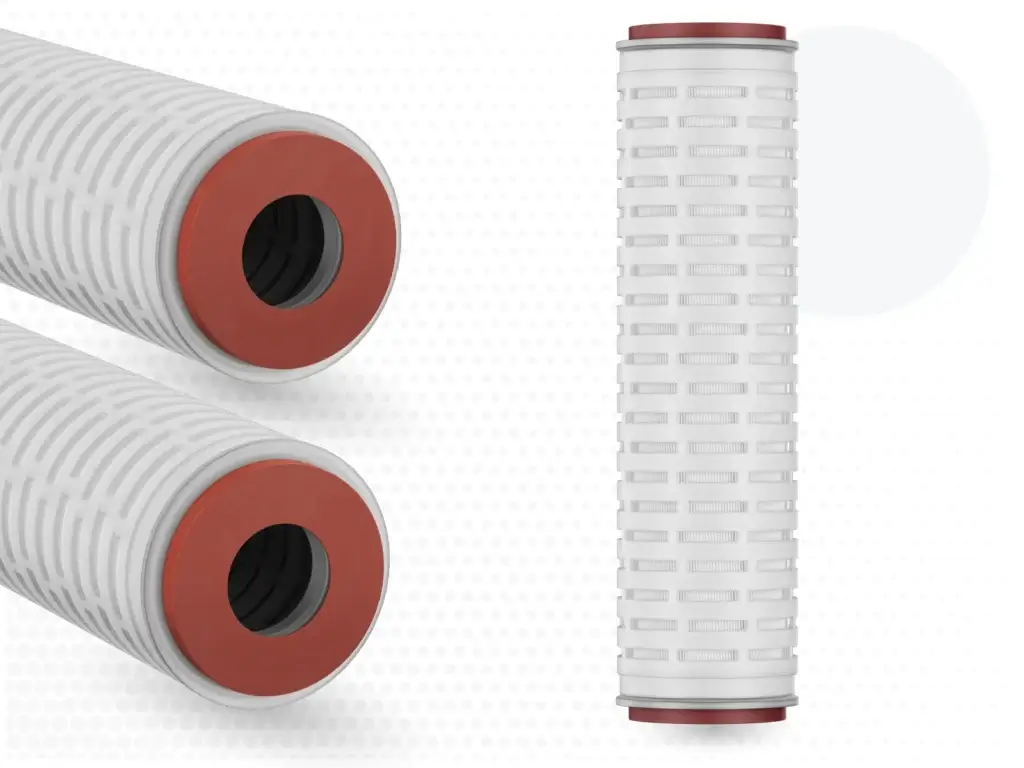
Pleated micro cartridge filters provide absolute filtration from 0.11 to 50 µm, with PP, PES, PTFE, glass fibre, nylon and PVDF membrane options. Because the pleated design offers a large surface area, the pressure drop stays low despite the fine pores.
An absolute rating only holds when the cartridge is fitted correctly. If the O-ring or gasket does not seat fully in the socket, a bypass path opens and the absolute rating no longer applies. See our guide to cartridge filter end caps for why the end type matters.
How do you read the beta ratio and efficiency?
The clearest way to compare filter efficiency in numbers is the beta (β) ratio. The number of particles above a given size at the filter inlet is divided by the number at the outlet:
- If β = 2, half of the particles are retained and efficiency is 50%.
- If β = 10, efficiency is 90%.
- If β = 100, efficiency is 99%.
- If β = 1000, efficiency is 99.9%.
The efficiency formula is: Efficiency (%) = (1 − 1/β) × 100. If a technical data sheet says something like “β ≥ 1000 at 5 µm”, the filter retains 99.9% of particles larger than 5 µm. This level is typically the target for an absolute rating.
Nominal and absolute filters compared
| Property | Nominal filter | Absolute filter |
|---|---|---|
| Retention principle | Depth filtration | Surface (membrane) filtration |
| Retention at the stated size | Most particles (80–95% for felt bags) | Almost all (typically β ≥ 1000) |
| Dirt-holding capacity | High | Lower; the surface loads quickly |
| Cost | Low | High |
| Typical duty | Pre-filter, reducing the dirt load | Final filter, product safety |
| Example products | Melt blown, string-wound, felt bag | Pleated micro cartridge |
Which should you choose for which process?
- Ask what a leak would cost. If a single particle passing through spoils the product, damages equipment or creates a microbiological risk, you need an absolute filter. Pharmaceuticals, beverages, membrane pre-treatment and the final stage of coating lines belong to this group.
- Assess the dirt load. If the liquid carries a lot of sediment, an absolute filter will clog quickly. In that case, the load is first reduced with a nominal depth filter.
- Build in stages. The most economical setup usually combines a nominal pre-filter with an absolute final filter. Pre-filtration can extend the service life of a pleated cartridge by up to 3 times.
- Choose the micron rating for the target. Determine the smallest particle you want to retain. The absolute final filter is chosen at that size, and the pre-filter a few times coarser.
- Verify the seal. With an absolute filter, the end type and O-ring choice matter as much as the micron rating. Check that the cartridge is seated in its socket before start-up.
Frequently asked questions
Does a 5 micron filter retain all 5 micron particles?
Is an absolute filter always better?
What is the beta ratio?
Can bag filters provide absolute filtration?
Which cartridge is used for sterile filtration?
Ask our team
Share your liquid, the particle size you want to retain and your flow rate, and we will set up the nominal pre-filter and absolute final filter stages together. Browse our cartridge filter products, or contact us for a quote.