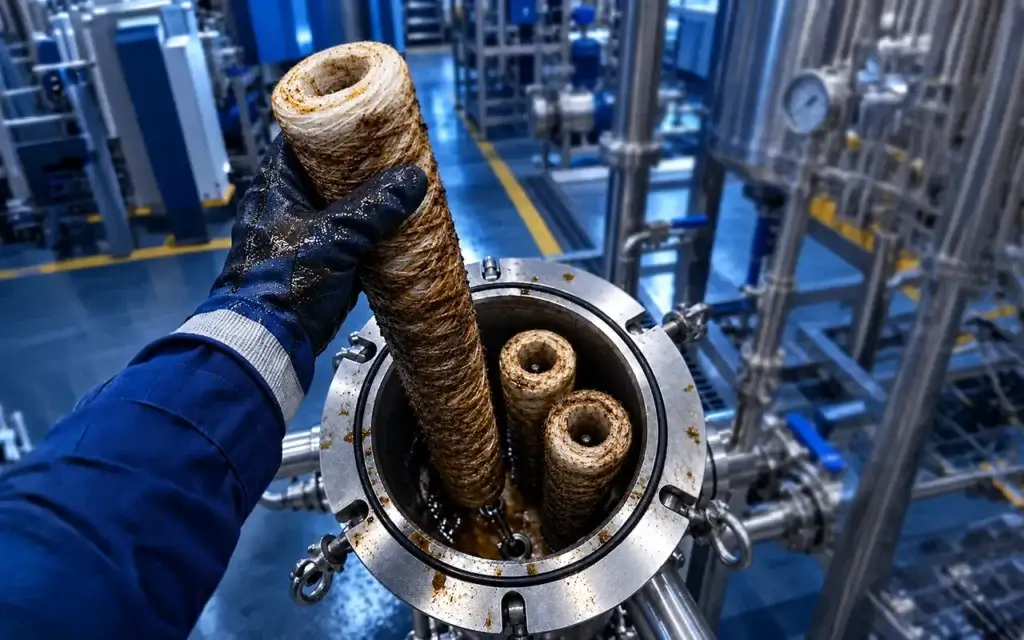
Why does differential pressure determine replacement time?
As a cartridge retains particles, its pores fill up and it becomes harder for the liquid to pass through. This resistance is measured as the pressure difference between the housing inlet and outlet: ΔP = inlet pressure − outlet pressure.
The same cartridge can last six months on one line and one week on another. The dirt load of the liquid and the flow rate determine this. In plants that do not monitor differential pressure, cartridges are either replaced too early and wasted, or replaced too late, creating a risk of bypass and collapse.
At what differential pressure should a cartridge be replaced?
The threshold depends on the cartridge design. The recommended values for Prosestim products are:
| Cartridge | ΔP to plan replacement | ΔP not to exceed | Reuse |
|---|---|---|---|
| Melt blown | 2.0–2.4 bar | 2.4 bar | No, single use |
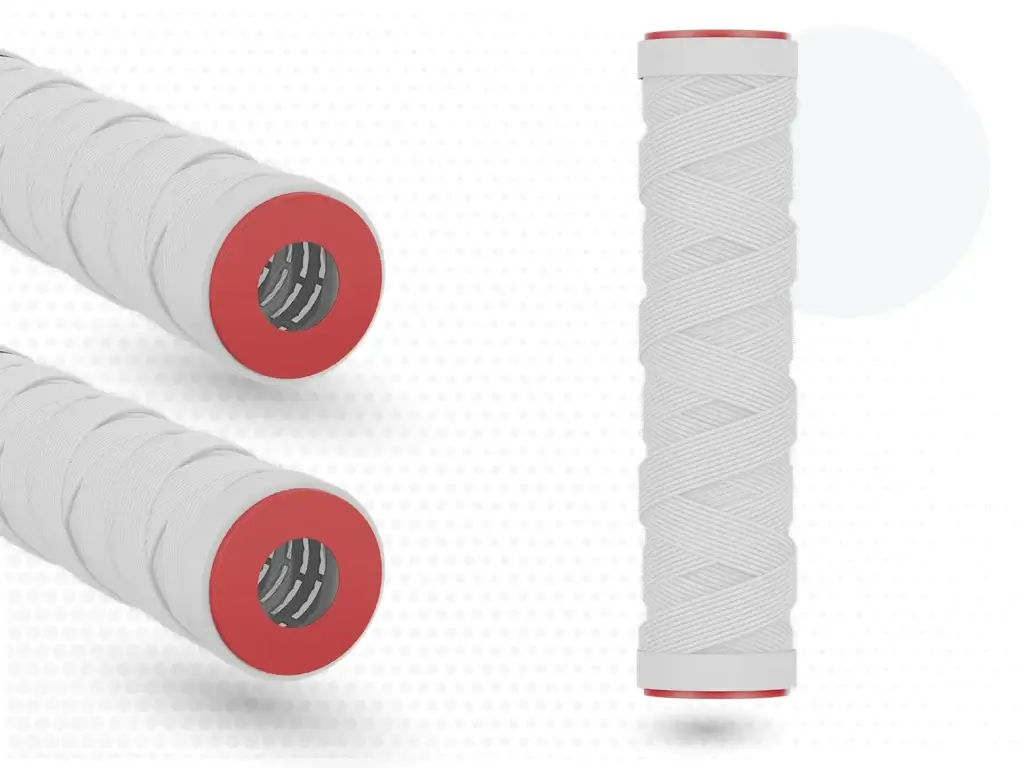
| String-wound | 2.0–2.4 bar | 2.5 bar (30 °C, normal flow) | No, single use |
| Pleated micro | Per product data sheet | Per product data sheet | Limited backwashing (max. 60 °C and 1 bar) |
| Washable PP / SS mesh | Per product data sheet | Per product data sheet | Yes, by washing |
The permitted differential pressure falls as temperature rises. For example, a melt blown cartridge should be operated at no more than 2 bar ΔP at 65 °C. On hot lines, plan replacement earlier.
How do you monitor differential pressure?
- Use two pressure gauges. Fit one gauge at the housing inlet and one at the outlet. A single gauge shows only line pressure, not how loaded the cartridge is.
- Record the clean cartridge value. Note the ΔP when a new cartridge is fitted. Tracking the rise against this baseline makes replacement easier to predict.
- Read weekly. Read and record the gauges at least once a week. If you see ΔP rising quickly, plan the replacement in advance.
- Calibrate the gauges. Check the calibration of the inlet and outlet gauges at least every six months.
In plastic cartridge filter housings with a clear bowl, a marked change in the colour of the cartridge surface is also a practical sign, but the final decision should be based on differential pressure.
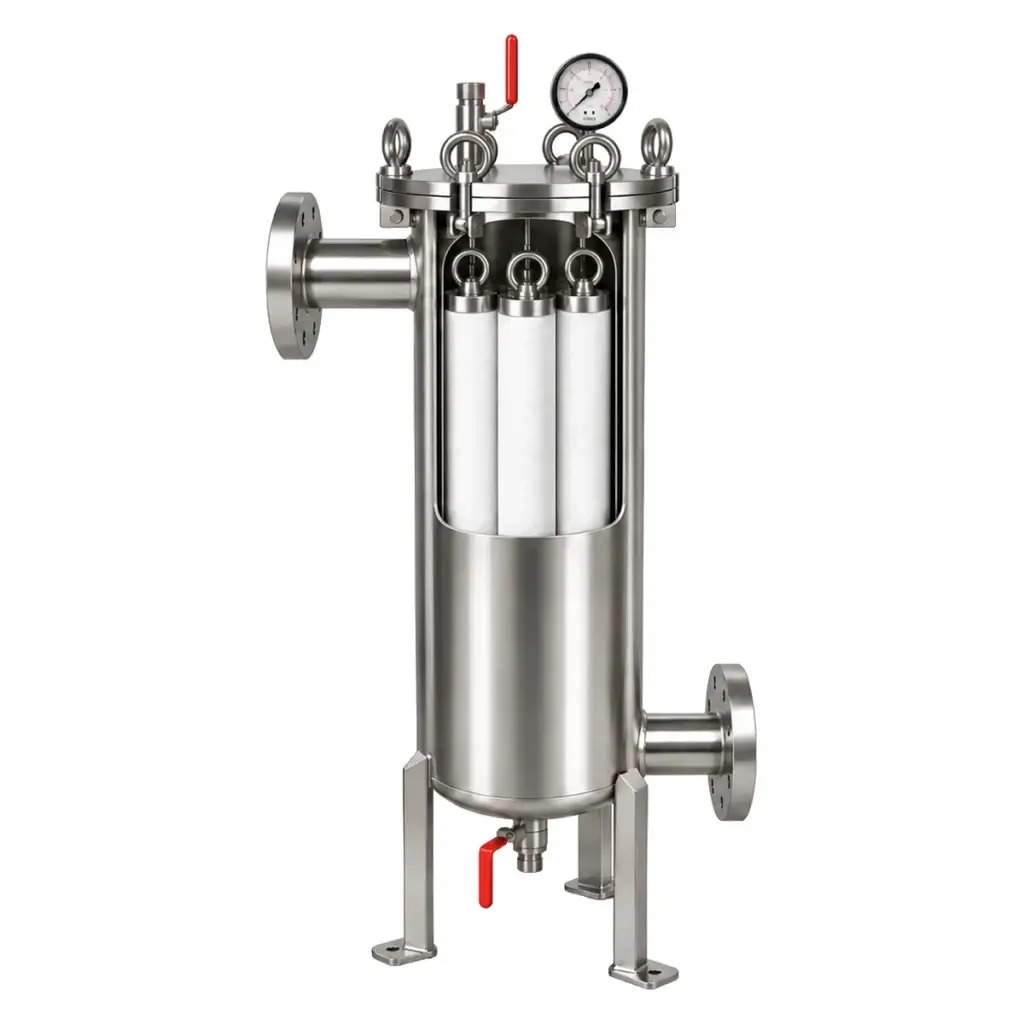
What are the risks of replacing a cartridge too late?
A cartridge past its saturation point no longer retains more particles; it starts causing problems:
- Bypass: Rising pressure forces the liquid into the smallest gap between the cartridge and its socket, and it passes through unfiltered.
- Media compression or collapse: Excessive differential pressure compresses the depth structure; retained particles can escape to the outlet.
- Loss of flow and higher energy use: The pump has to work harder to deliver the same flow rate.
Early replacement is less visible but just as costly: part of the cartridge’s dirt-holding capacity is thrown away unused.
What should you do if the cartridge clogs too quickly?
If the replacement interval is much shorter than expected, the problem usually lies in how the system is set up:
- Check the micron rating. A finer rating than you need fills the cartridge with coarse particles. The finer the rating, the higher the initial pressure drop as well.
- Add a pre-filter. With a high particle load, a coarser pre-filter can extend the life of the main cartridge by up to 3 times.
- Switch to a bag if the dirt load is very high. On lines with heavy sediment and high flow rates, a bag filter housing is more economical as the first stage.
- Increase the cartridge area. A longer length, a Big diameter or a cartridge filter housing with more cartridges lowers the differential pressure at the same flow rate.
- Choose the media for the liquid. In viscous and oily liquids, resin-bonded or string-wound cartridges can last longer thanks to their depth structure.
How do you replace a cartridge step by step?
- Close the inlet and outlet valves and release the pressure in the housing through the drain valve.
- Open the lid and remove the dirty cartridge.
- Clean the inside of the housing, the O-ring sockets and the sealing surfaces; replace any damaged O-ring.
- Seat the new cartridge fully in its socket. Twist to lock a 226 cartridge; compress a DOE cartridge with the compression rod.
- Close the lid, open the inlet slowly to vent the air, and pressurise the line.
- Record the initial ΔP of the clean cartridge.
Frequently asked questions
How often should a cartridge filter be replaced?
What is differential pressure (ΔP)?
Can melt blown and string-wound cartridges be washed?
Is one pressure gauge enough?
What happens if I replace the cartridge too late?
How can I extend the replacement interval?
Ask our team
If your cartridges are filling up faster than expected, share your flow rate, liquid and current ΔP records, and we will review the staging and housing setup together. Browse our cartridge filter products for options, or contact us for a quote.