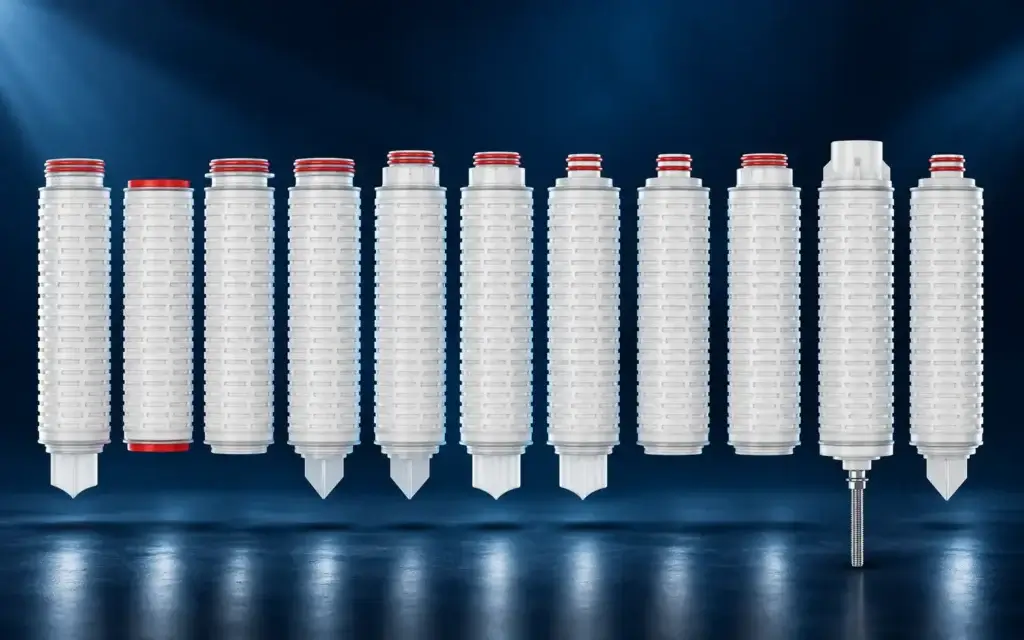
Why does the cartridge end matter so much?
No matter how finely a filter cartridge filters, if its end does not seal fully inside the housing, the liquid takes the easiest path and flows around the cartridge. This is called bypass (flow that passes without being filtered). On a line with bypass, the difference between fitting a 1 µm cartridge and fitting no cartridge at all is much smaller than you would expect.
That is why the end cap type is as important an ordering detail as the micron rating. The most common mistake we see in the field is buying a cartridge with the right micron rating and the right length whose end does not fit the housing. In DOE models, when the end gaskets do not seat fully, filtration efficiency can drop by up to 50%.
What is the difference between DOE and SOE cartridges?
Cartridge ends fall into two main families:
- DOE (Double Open End): A cartridge open at both ends. The ends have flat gaskets, or the gasket sits inside the housing. The cartridge is compressed axially between the housing lid and the base of the body, and this pressure provides the seal.
- SOE (Single Open End): A cartridge open at one end and closed at the other. The open end has an O-ring adapter. The adapter sits in the socket at the base of the housing, and the O-ring compresses radially to provide the seal.
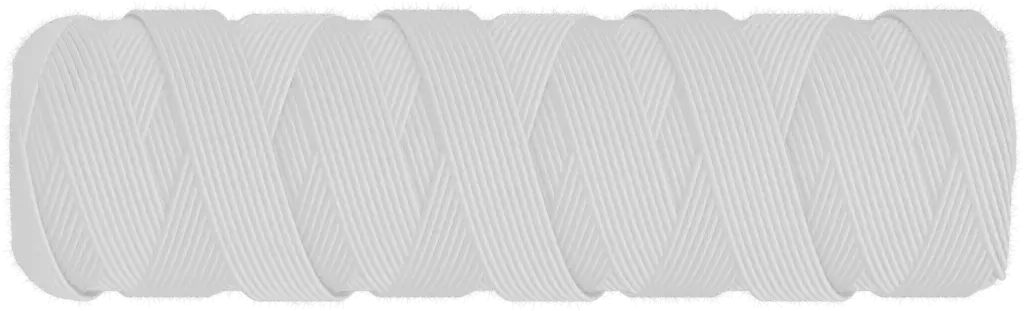
DOE cartridges are economical and widely used for general-purpose pre-filtration. SOE cartridges cost more, but because they seat in a socket, the risk of bypass drops markedly when they are fitted correctly. This is why O-ring ends are preferred for sensitive final filtration, for example on lines that use a pleated micro cartridge filter.
What do the codes 215, 222 and 226 mean?
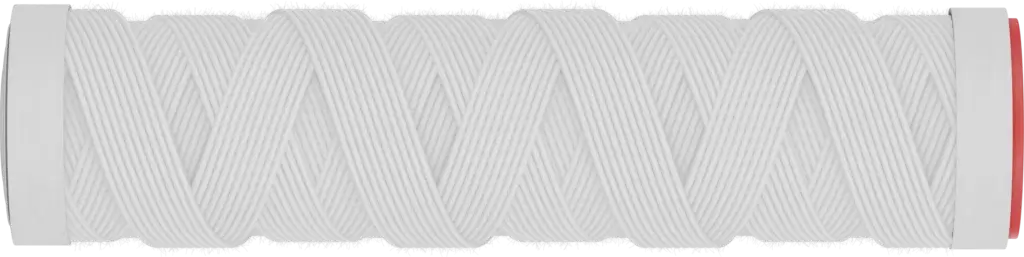
On SOE cartridges, the codes 215, 222 and 226 indicate the standard size number of the O-ring on the adapter. The codes define the end interface that sits inside the housing, so a cartridge with a given code can be used in different housings that have a socket with the same code.
- 215: A smaller-diameter O-ring adapter. It is pushed into the socket.
- 222: The most common O-ring adapter. The cartridge is pushed into the socket and held in place by the pressure of the O-rings.
- 226: Has a similar O-ring design to 222, but the adapter has locking tabs. 226 is the only end type that locks with a twist. When the cartridge is placed in the socket and turned, the tabs lock into their counterparts in the socket; this keeps the cartridge from lifting out on lines with vibration and pressure fluctuations.
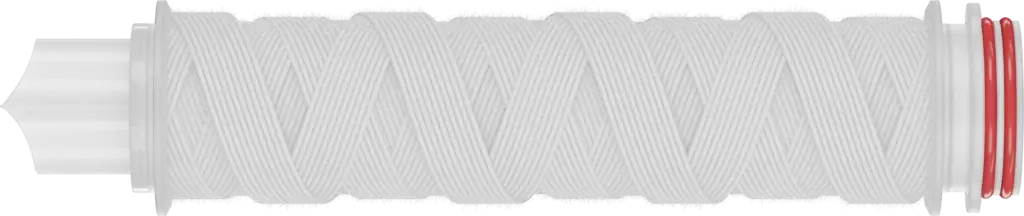
The cap geometry at the closed end is a separate choice. Prosestim cartridges are available with Flat, Fin 1 and Fin 2 end caps. The cap is chosen to match its counterpart in the housing lid, so a photo or sample of your current cartridge is the most reliable reference when ordering.
Comparison of end cap types
| End type | Design | Sealing | Where it is preferred | Watch out for |
|---|---|---|---|---|
| DOE | Open at both ends, flat gaskets | Axial compression between lid and base | General-purpose pre-filtration, economical operation | Gaskets must seat fully; not used on lines with backwashing |
| SOE 215 | Closed at one end, small O-ring adapter | Radial O-ring compression | Housings with a 215 socket | Socket size must be confirmed |
| SOE 222 | Closed at one end, O-ring adapter | Radial O-ring compression, push-in fit | Fine filtration, the most common industrial housings | The cartridge can be pushed up by pressure fluctuations |
| SOE 226 | Closed at one end, O-ring + locking tabs | Radial O-ring compression, twist-lock | Lines with vibration, pressure fluctuations and critical duty | The housing must have a 226 locking socket |
Which end type fits which housing?
The housing socket determines which end you use. First check which ends your housing accepts:
- The stainless steel cartridge filter housing is built to work with 215, 222 and 226 O-ring cartridges as well as DOE cartridges. With DOE cartridges, a compression rod in the housing compresses the gasket axially.
- The plastic cartridge filter housing accepts gasketed (DOE) and O-ring cartridges. A DOE cartridge is compressed between the lid and the base of the body.
- The Prolite filter housing works with standard cartridges in its 4-cartridge model; its compression system keeps the cartridge from bypassing.
Length and diameter matter as much as the end type. Standard cartridges have an outer diameter of 58 mm, Big cartridges 107 mm. If a standard cartridge is fitted in a Big housing, the liquid passes through unfiltered.
Choose the right end type step by step
- Identify the housing. Look at the cartridge seat: a flat seating surface with a compression rod means a DOE cartridge; an O-ring socket means an SOE cartridge.
- Determine the socket code. The adapter of your current cartridge is marked 215, 222 or 226, or has visible locking tabs. If it has tabs, it is a 226.
- Match the closed-end cap. Compare the Flat, Fin 1 or Fin 2 cap with your current cartridge.
- Measure length and diameter. Note the length (5″, 10″, 20″, 30″ or 40″) and whether it is standard or Big diameter.
- Choose the seal material. Pick the option suited to your fluid from silicone, NBR, EPDM, Viton or PTFE. See our guide to O-ring and gasket materials for help.
- Check during installation. Seat the cartridge fully in its socket, make sure the O-ring or gasket is not twisted, and bring the pressure up slowly at first start-up.
Frequently asked questions
Can DOE and SOE cartridges be used interchangeably?
What is the difference between 222 and 226 cartridges?
How can I tell my cartridge's end type?
What happens if the wrong end type is chosen?
Which end type should be used on lines with backwashing?
Can I fit cartridges with a different micron rating in the same housing?
Ask our team
Share a photo of your cartridge or housing, and we will work out the end type, cap and seal material together. Browse our cartridge filter products for options, or contact us for a quote.