How does a liquid bag filter work?
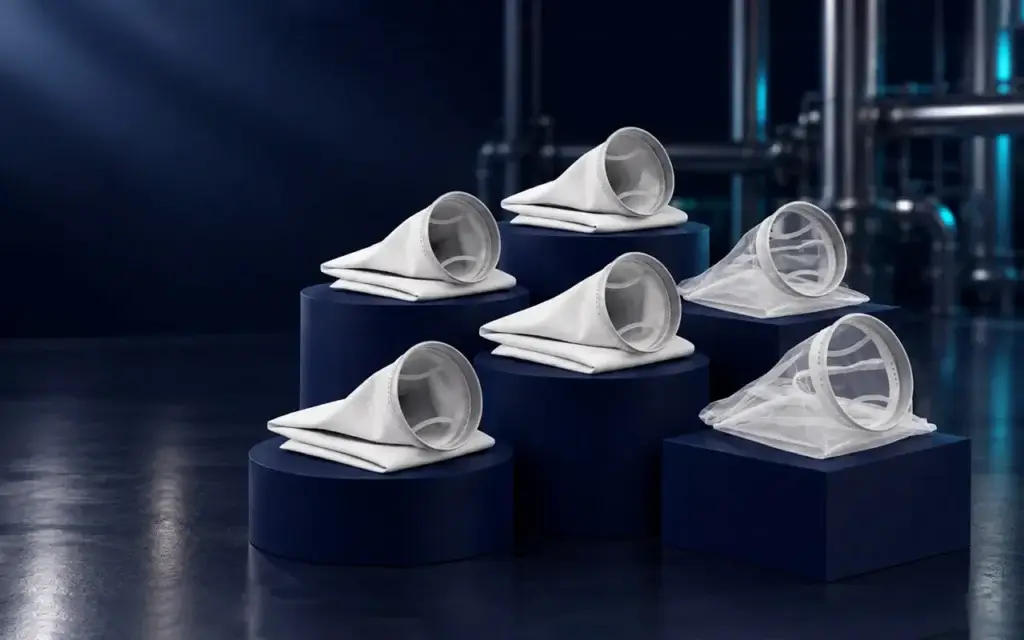
Liquid bag filters work from the inside out. The dirty liquid enters the bag from the top and exits through the bag fabric; particles above the micron threshold stay inside the bag. When the bag is changed, all of the dirt is removed with it and the housing stays clean.
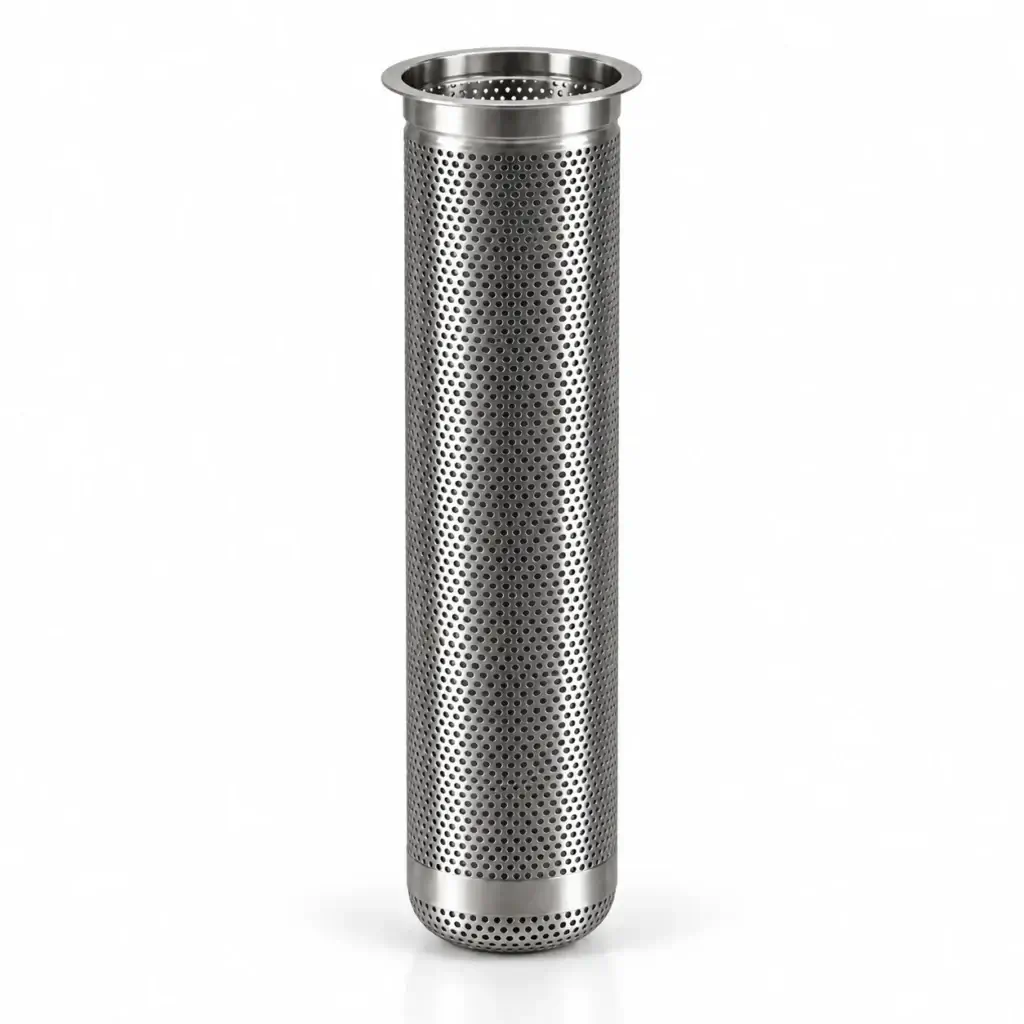
The bag sits in a support basket made of 4 mm perforated sheet inside the bag filter housing. The basket keeps the bag from ballooning and tearing as pressure rises. Bag filters are made about 10 cm longer than the basket; this allowance lets the bag rest against the basket under pressure.
What is a felt bag filter?
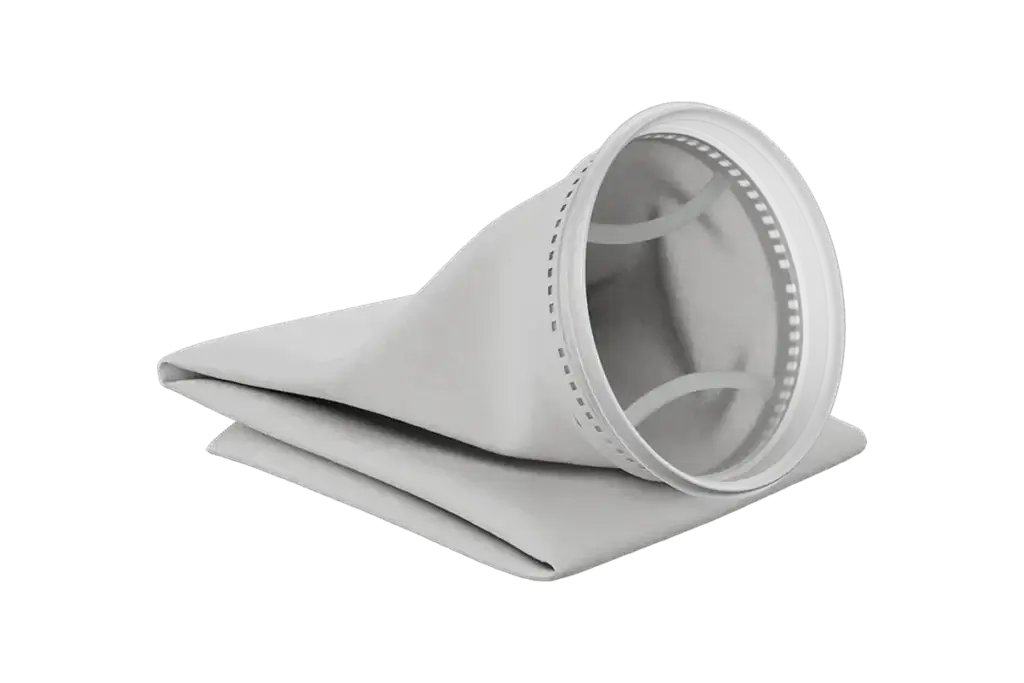
Felt is a nonwoven fabric whose fibres are bonded by needle punching. As liquid passes through felt, particles are retained not only at the surface but throughout the whole thickness of the fabric. This depth structure gives the bag a high dirt-holding capacity.
- Polypropylene felt bag filter: 1–200 µm, pH 1–14 chemical compatibility, 90 °C continuous operation. For liquids containing acids and alkalis, and for chemical and water lines.
- Polyester felt bag filter: 1–200 µm, resistant up to 135 °C, pH 2–12, silicone-free production. For paint, coating and hot process lines.
Felt bag efficiency is nominal; particle retention ranges from 80% to 95% depending on the micron rating. Felt bags are single use; because particles are embedded deep in the fibres, washing does not restore their original performance.
What is a monofilament bag filter?
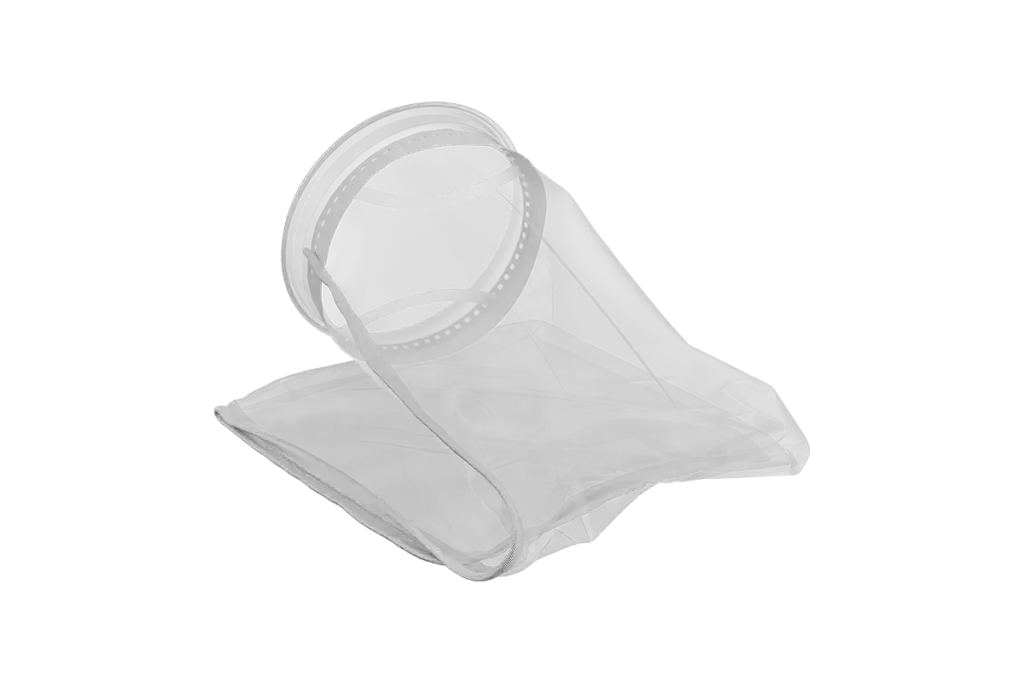
Monofilament fabric is woven from a single strand. The weave forms fixed square pores, and particles are retained on the surface of these pores. Because the pore opening does not change during use, it provides an exact micron cut-off, and the bag can be washed and reused.
- Monofilament polyester bag filter: 20–1000 µm, 135 °C, pH 2–12. For the final stage of paint and coating lines, and general surface filtration.
- Nylon (polyamide) monofilament bag filter: 20–1000 µm, 100 °C, pH 2–11. With high abrasion resistance, for liquids carrying abrasive particles.
For rigid particles, the retention efficiency of a monofilament bag is above 90%. Nylon starts to soften above 100 °C and the pore geometry deteriorates; polyester should be preferred on hot lines.
When is a multifilament bag filter used?
Multifilament fabric is made by twisting many fine filaments together and weaving them. It is an economical surface filter for coarse and medium particles. The multifilament PP bag filter works from 75 to 1500 µm, with pH 1–14 chemical compatibility and a temperature limit of 82 °C. On lines that require 135 °C, a multifilament polyester bag is used. Multifilament bags can be washed to a limited extent; if you want regular reuse, monofilament is a better fit.
Felt, monofilament and multifilament compared
| Property | Felt | Monofilament | Multifilament |
|---|---|---|---|
| Fabric structure | Needle-punched nonwoven | Single-strand weave | Twisted multi-filament weave |
| Filtration type | Depth | Surface, fixed pores | Surface |
| Micron range | 1–200 µm | 20–1000 µm | 75–1500 µm |
| Retention efficiency | Nominal, 80–95% | Above 90% for rigid particles | 90% and above |
| Dirt-holding capacity | High | Low; a cake forms on the surface | Medium |
| Reuse | No | Yes, by washing | Limited |
| ΔP for replacement or washing | 1.0–1.5 bar for PP felt | 0.5–1.0 bar (max. 2.0 bar) | Per product data sheet |
| Typical use | Gels, deformable particles, fine filtration | Rigid and abrasive particles, exact cut-off | Coarse, economical pre-filtration |
Choose the right bag filter step by step
- Know your particle. Gel-like, soft or deformable particles can squeeze through monofilament pores; choose felt for these. For rigid particles such as sand, rust and metal chips, monofilament gives a definite result.
- Set the micron rating. Felt is used for fine filtration from 1 to 200 µm, monofilament for an exact cut-off above 20 µm, and multifilament for coarse filtration above 75 µm. If you need precision below 0.5 µm, a cartridge filter housing is a better fit.
- Match temperature and chemistry. Choose PP (pH 1–14) for acids and alkalis, and polyester (135 °C) for high temperatures. PP felt is limited to 90 °C, multifilament PP to 82 °C and nylon to 100 °C.
- Check process-specific requirements. On paint and coating lines, use silicone-free bags to avoid the risk of craters. For oily liquids, consider special oil-absorbing bags.
- Match the size and collar. Standard sizes are Ø180 × 430 mm, Ø180 × 810 mm, Ø100 × 230 mm and Ø100 × 380 mm. Choose the collar type (PP ring, steel snap ring, drawstring, snap band, flanged) based on a photo or sample of your current bag.
- Choose the housing for the pressure. Standard stainless steel bag filter housings are built to PN16 (16 bar). For lines below 8 bar, the Prolite filter housing, with a clamp lid and AISI 304 body, is an economical option.
Frequently asked questions
Can a felt bag filter be washed?
Which filters finer, monofilament or felt?
When should a bag filter be replaced?
Why does a bag filter housing need a basket?
Which bag filter is used on a paint line?
Should I choose a bag filter or a cartridge filter?
Ask our team
Share your liquid, temperature, flow rate and the particle you want to retain, and we will choose the media, micron rating and bag size together. Browse our bag filter products, or contact us for a quote.