
Filter Housing Connection Fittings and Manifold Groups
Manifold, Parallel and Series Connection Groups
Filter housing connection fittings are assemblies that join cartridge, bag and basket filter housings with a manifold system, in parallel or in series. In a parallel connection, each housing has its own valve at the inlet and outlet; one housing can be shut off with its valve and cleaned while the other keeps running.
5 options
2 — multiple
DN15–DN200
Flange, Socket, Nipple, Union, Clamp
What are filter housing connection fittings?
Filter housing connection fittings are assemblies that join several filter housings on a single process line. They consist of inlet and outlet manifolds, connecting pipework, valves and connection fittings. Their job is to join the housings and, depending on the connection type, make maintenance easier; with a parallel connection, each housing can be isolated from the line on its own.
On a line with a single housing, production has to stop for a filter change: the housing cannot be isolated or depressurised, and the line cannot restart until the cartridge, basket or bag has been replaced. A parallel system removes this constraint. Each housing has its own valve at the inlet and outlet, so the flow to the housing being serviced is shut off, the housing is isolated and the other housing keeps filtering. When both housings run together, the filtration capacity also doubles. With a manifold system, all housings are connected through a common manifold to a single inlet line and a single outlet line; the aim is to gather the housings on one line. The purpose of a series connection is staged filtration: the flow passes through the housings in turn, the first housing holds back coarse particles and the next one filters finer, so the fine filter lasts longer and consumable costs fall. Because the flow follows a single path, the line stops for a filter change.
The fittings are not an off-the-shelf product. They are made to order for each project, based on the number of housings, housing size, connection type, operating pressure, fluid type and flow rate.
- Connection Layout
- Manifold Connection (all housings connect through a common manifold to a single inlet line and a single outlet line)
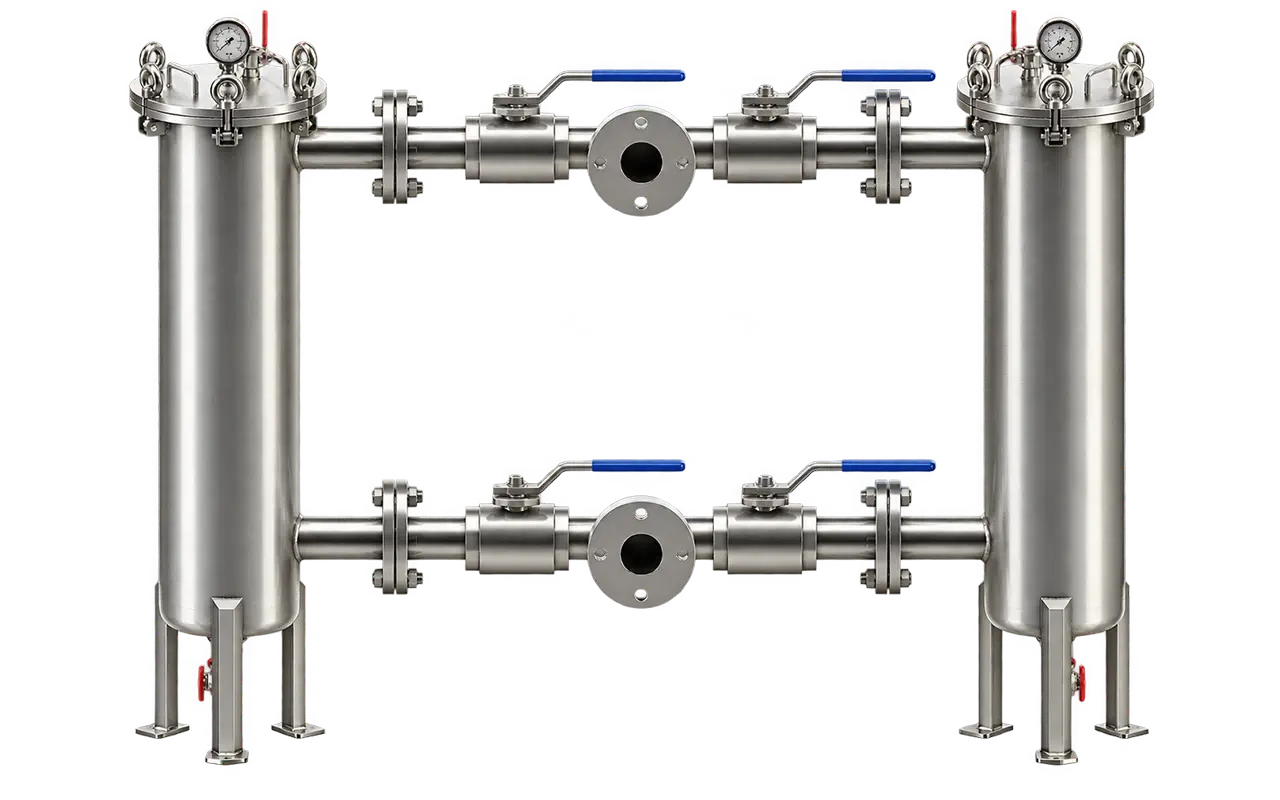
- Parallel Connection (two housings are joined; capacity doubles, and one can be cleaned while the other runs)
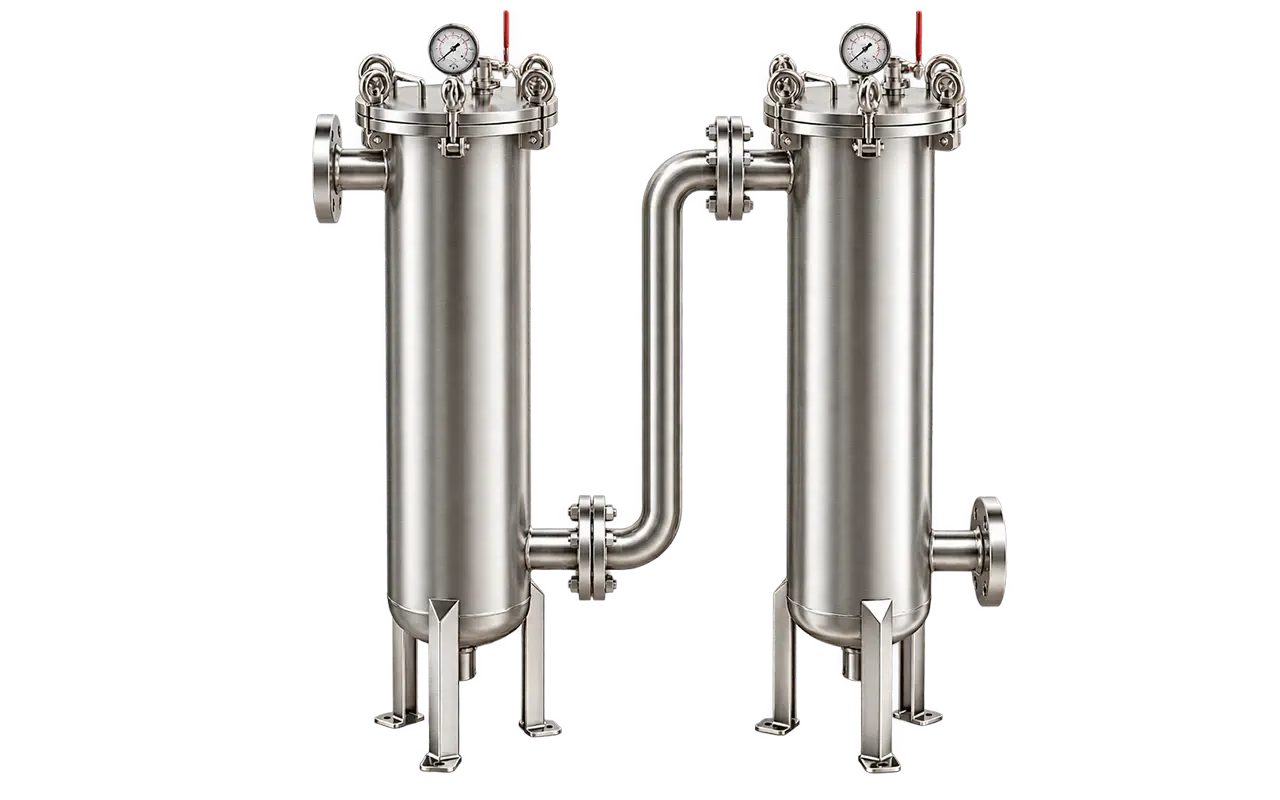
- Series Connection (staged filtration from coarse to fine filter; the line stops for maintenance)
- Connection Method
- Detachable (Flanged, Union, Clamped)
- Welded One-Piece Pipe Connection
- Classification Logic
- The fittings are classified on two axes: how the housings are connected (manifold, parallel or series) and whether the fittings can be dismantled during maintenance.
Your housing's connection type decides where the fittings are separated
A detachable series connection has a union, clamp or flange in the middle
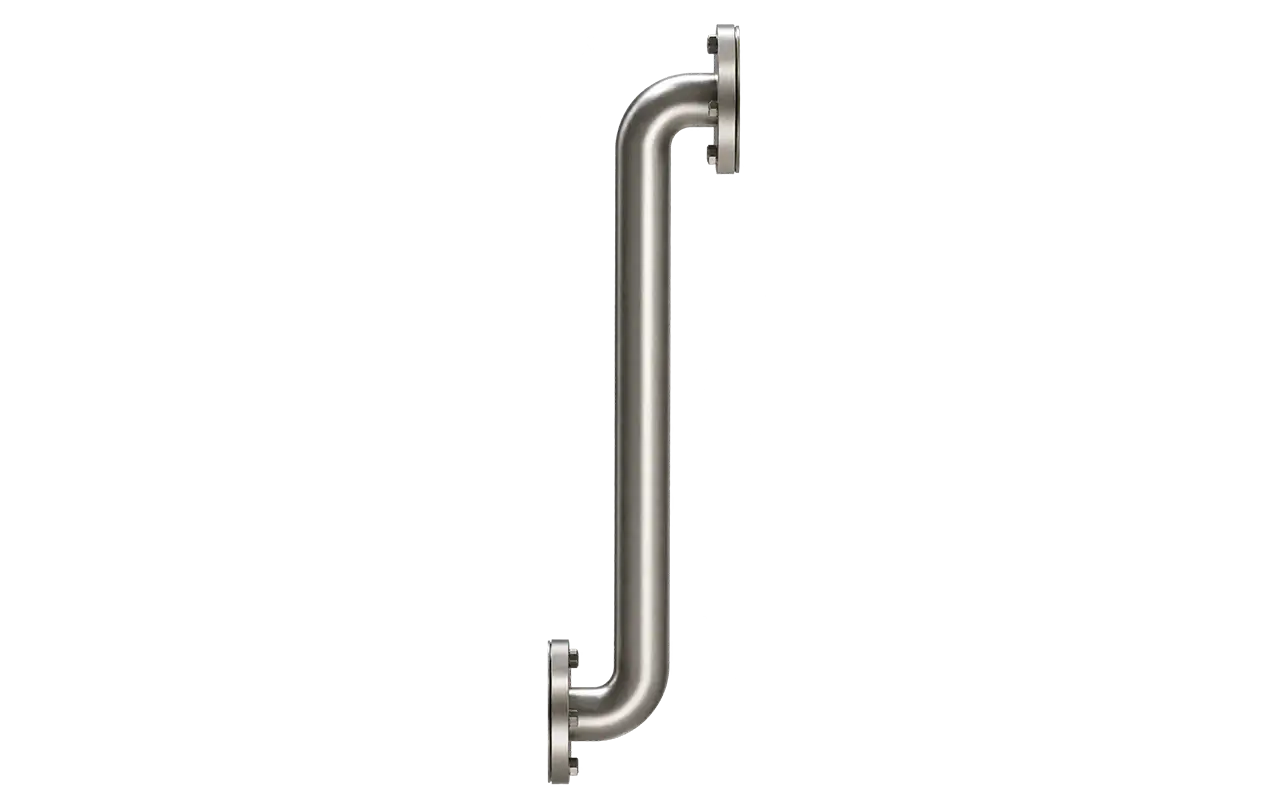
In a series connection, the bottom outlet of the first housing is connected to the top inlet of the second. If a detachable connection is preferred, a union, clamp or flange is added in the middle of the line; the housings are separated at this connection point and can be detached from each other.
A welded (non-detachable) series connection needs no separating part, but the housings cannot be separated later. If you need them to be detachable, the union, clamp or flange must be planned at the manufacturing stage.
Two housings are connected in parallel
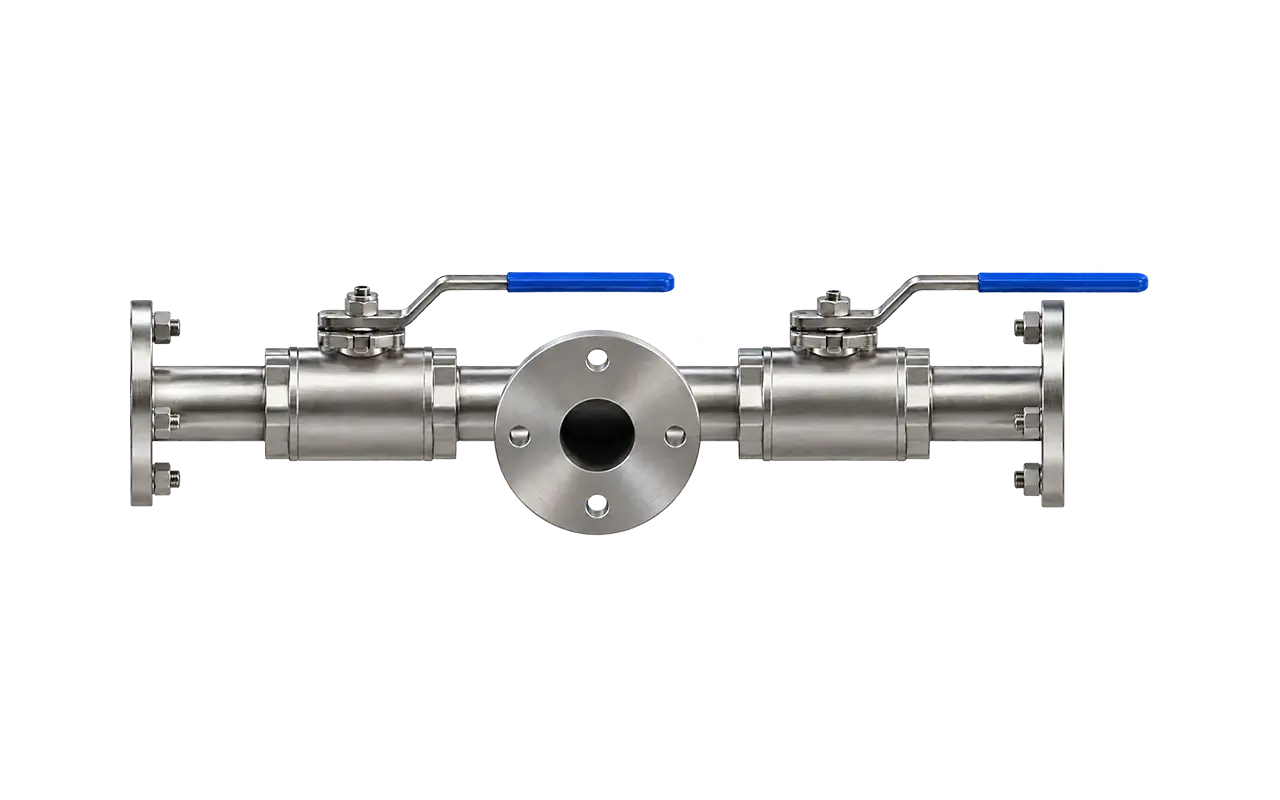
In a parallel system, two filter housings are joined with ball valves, clamp, union or flange connections and a T-piece. The system continues with the same connection type as the housing inlet and outlet, and the housings are separated at these connections. Thanks to the valves, one housing can be stopped and cleaned while the other keeps running; when both housings run together, the capacity doubles.
No additional union is needed. This is the preferred layout on hygienic lines.
Connects regardless of inlet or outlet side
All housings connect to a common manifold; the system is fed from a single line and discharges through a single line. This gives a lot of flexibility in site layout and when adapting to existing pipework; which end of the manifold is used for the feed does not limit manufacturing.
The housings are separated at the connections on the manifold ends; whether a union is needed for your housing type is confirmed at the quotation stage.
Which type of connection should I use?
Share your line conditions and we will tell you:
- Whether to use a manifold, parallel or series connection
- How many filter housings you need
- Which of the five fitting types suits you
- Where the separation point should be and whether a union is needed
Five fitting types, two key decisions
How will the housings be connected (manifold, parallel or series), and will the fittings be detachable from the system? The second question determines your maintenance costs over the life of the equipment.
- Type 1: Detachable Manifold
- Connection: Manifold: all housings connect to a single inlet line and a single outlet line (2 or more filter housings).
Maintenance & Valves: Detachable union/flanged construction; valves can be replaced and the system serviced easily.
Assessment: The professional solution most often chosen for high-flow industrial lines. - Type 2: Detachable Series Connection
- Connection: Series / staged (from coarse to fine filter).
Maintenance & Valves: Detachable union/clamp connection; once the line is stopped, the housings can be removed independently of each other. One housing cannot be cleaned while the other is running.
Assessment: The recommended standard design for processes that build a precise micron sequence. - Type 3: Detachable Parallel with Ball Valves
- Connection: Parallel: two housings are joined to each other (maximum 2 housings).
Maintenance & Valves: Detachable; one housing can be shut off with its valve and cleaned while the other runs, and the valves are easy to remove and replace.
Assessment: An economical, modular option that takes up minimal space in twin-housing applications. - Type 4: Welded Manifold
- Connection: Manifold: single inlet and single outlet line, permanently welded.
Maintenance & Valves: Not detachable; if a valve fails, the whole manifold line has to be cut.
Assessment: Not recommended for new installations because maintenance and valve replacement are impossible. - Type 5: Welded Series Connection
- Connection: Series / permanently welded staged line.
Maintenance & Valves: Pipework that cannot be dismantled.
Assessment: Not recommended because it offers no flexibility and makes line revisions difficult.
Detachable manifold connection fittings for filter housings
- RECOMMENDED
- 2 or more housings
Connects all filter housings to a common manifold; the system is fed from a single line and discharges through a single line. It is used to gather several housings on one process line.
Because the fittings are not welded, they can be detached from the system and the filter housings can be made independent.
- Capacity can be increased by adding housings to the manifold
- Simple pipe layout with a single inlet and a single outlet line
- Valves, seals and manifold parts can be replaced one by one
- The line can be repositioned later
APPLICATIONS
Continuously running high-flow process lines, water treatment pre-filtration, paint and chemicals, food and beverage, cosmetics and pharmaceutical filling lines.
Detachable series connection fittings for filter housings
- RECOMMENDED
- Staged filtration
The filter housings are connected one after another in the direction of flow. The first housing holds back coarse particles and the following housings filter at progressively finer micron ratings, which noticeably extends the life of the more expensive fine filter.
With these series connection fittings, the filter connections can be separated from each other and made independent. Because the flow passes through all housings in turn, one housing cannot be stopped and cleaned while the other runs; filter changes and cleaning are done with the line stopped.
- Longer filter life and lower consumable costs with staged filtration
- Compact layout in tight spaces
- Easy maintenance and revision thanks to the detachable design
- The line stops during maintenance. If the line must never stop, series-connected housing groups can be connected to each other in parallel; choosing a parallel connection alone instead of series would defeat the purpose of staged filtration.
APPLICATIONS
Detachable parallel connection fittings with ball valves for filter housings
- Ideal for 2 housings
- Maximum 2 housings
Connects two filter housings in parallel. When a filter change is needed, the ball valve on the fittings shuts off the flow to the housing being serviced; that housing is cleaned while the other keeps running.
Each inlet and outlet has its own valve, so cartridge, basket or bag filters can be changed by taking a housing in and out of service in a controlled way. The fittings can be detached from the system to make the filter housings independent. The housings are placed with their inlets and outlets facing each other, and the connecting line runs between the two housings.
- Full opening and closing in one move with a ball valve
- Low pressure loss with a full-bore valve
- Ideal for a “duty / standby” setup
APPLICATIONS
Welded manifold connection fittings for filter housings
- Not recommended
- Can be manufactured
Connects all filter housings to a common manifold; the system is fed from a single line and discharges through a single line.
Because the fittings are welded, they cannot be detached from the system.
- A failed valve cannot be replaced
- The housings cannot be removed and the line cannot be reconfigured
Note
We can manufacture it. We recommend building the same layout with the detachable manifold type; the reasons are explained below.
Welded series connection fittings for filter housings
- Not recommended
- Can be manufactured
These series connection fittings are welded, so the filter housings cannot be made independent of each other. The staged filtration layout is kept and the housings work as one fixed unit.
- Cannot be dismantled; housings cannot be accessed one by one during maintenance
- One housing cannot be stopped and cleaned while the other runs; the line stops for maintenance
Note
If you need to be able to dismantle the system, consider the detachable series connection fittings.
Valves cannot be replaced on the welded type
With welded fittings, the connections cannot be dismantled. This is not a minor limitation: when a valve fails, it cannot be replaced. If the failed valve stays open, you cannot isolate that housing; if it stays closed, your capacity drops permanently. Either way, the repair means cutting the weld and stopping the line for a long time.
We can manufacture this type, but we do not recommend it. Building the same layout and capacity with a detachable manifold system costs slightly more at the outset and gives you much greater security over the life of the equipment.
Detachable manifold
Same manifold layout, same valve arrangement, same capacity. The difference: a failed valve can be replaced in place and the housings can be detached from the system.
Manufacturing ranges
The values below are the typical ranges most often requested. All fittings are made to order for each project, to suit your filter housing size and process conditions.
- Body / Manifold Material
- AISI 304 Stainless Steel
- AISI 316L Stainless Steel
- Connection Sizes
- Typically DN15–DN200 (½"–8"); custom sizes on request.
- Connection Types
- Nipple (Threaded) & Socket
- Union
- Hygienic Clamp (Tri-Clamp)
- DIN / ANSI Flange
- Operating Pressure
- PN10 (10 bar)
- PN16 (16 bar)
- PN25 (25 bar)
- Valve Type
- Ball Valve (Full-Bore Stainless)
- Butterfly Valve
- Compatible Filter Types
- Cartridge Filter Housings
- Bag Filter Housings
- Basket Filter Housings
- Surface Finish
- Buffing
- Production Method
- Made to order for each project, precisely built to your dimensions and layout plan.
Find the right connection type in four questions
- Uninterrupted operation or staged filtration?
- If the line must keep running while one housing is cleaned, choose a parallel connection. If you want to build a micron sequence, choose a series connection; the line stops during maintenance. In staged filtration, the first housing holds coarse particles and the second holds fine ones. Series-connected systems can be connected to each other in parallel, and parallel-connected systems can be connected to each other in series.
- Does it need to be removable?
- If you expect maintenance, revisions or valve replacement, always choose the detachable type. Valves cannot be replaced on welded types.
- What is the housing's connection type?
- On housings with clamp, union or flange connections, the fittings continue with the same connection type. In a series connection, if the housings need to be separated later, a union, clamp or flange is added in the middle of the line.
- What are the process conditions?
- The fluid type, temperature, operating pressure and flow rate determine the choice of material and size (304 / 316L and valve class).
Uninterrupted operation or staged filtration?
Does it need to be removable?
What is the housing's connection type?
What are the process conditions?
Products that work with this product
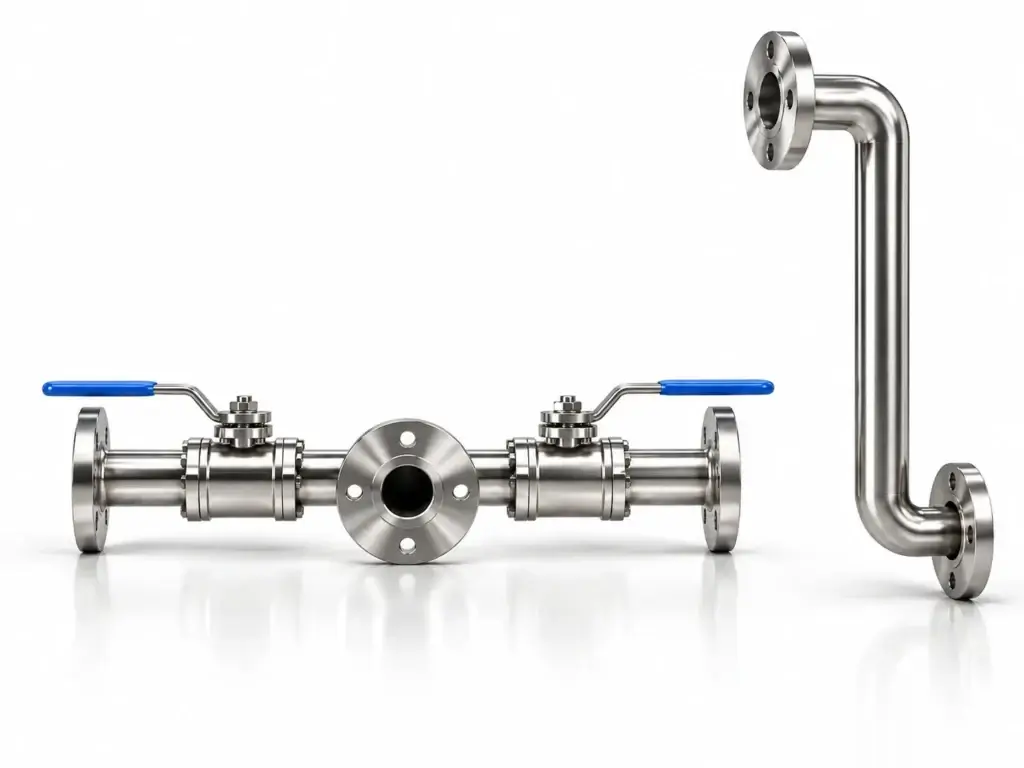
Filter Housing Connection Fittings
What is the difference between parallel and series connection?
Do I need to stop the line during a filter change?
Should I choose the welded or the detachable type?
We recommend the detachable type. With welded fittings, a failed valve cannot be replaced, which means long downtime and costly intervention. We can manufacture the welded type, but we do not recommend it for safe maintenance.
How many housings can be connected with parallel ball-valve fittings?
This type is designed for a maximum of two filter housings. If all housings are to be connected to a single inlet line and a single outlet line, manifold connection fittings should be used.
Can I separate series-connected housings later?
Yes, if you choose a detachable series connection. In that case a union, clamp or flange is added in the middle of the line, and the housings are separated at this connection point. These parts are not used in a welded series connection, so the housings cannot be separated later.
How are clamp or flanged housings separated?
With clamp, union or flanged inlets and outlets, the fittings continue with the same connection type and the housings are separated directly at these connection points. No additional union is needed.
Does inlet–outlet direction matter in a manifold connection?
Which filter types are they compatible with?
Standard product or custom-made?
Filter Housing Connection Fittings RFQ Configurator
Configure your variation dimensions and technical specifications to receive an instant quote directly on WhatsApp and via email.